
The Wisdom Drought


By Justin Foster
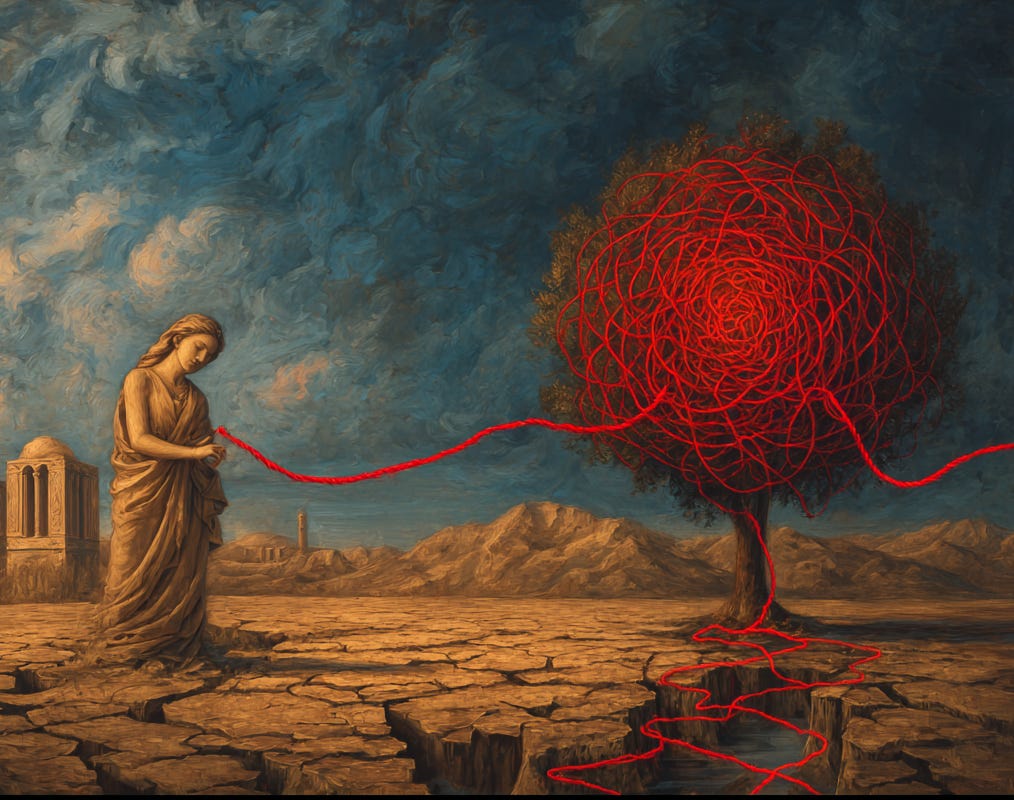
Leadership cultures across industries are operating inside a drought that quietly weakens their foundations. This is not a shortage of talent or expertise, and certainly is not from a lack of information and data. Instead, it is a withering of orientation, of rhythm, and of the history within culture.
This drought often enters unnoticed, precisely because the surface-level indicators look strong. Metrics improve, strategies sharpen, and communication cycles move faster and faster. Yet beneath that apparent momentum lies a growing unease; a quiet unraveling of purpose, conviction, and philosophical grounding. Leaders sense it in their bodies before they name it in their language. They feel the fatigue, the narrative drift, the cultural slack. Something essential has slipped beneath the surface.
I am calling this the Wisdom Drought
The Wisdom Drought reflects more than a temporary disorientation. It signals a deeper structural condition: the absence of a stabilizing center. When the compass loses its magnetism, performance becomes a ritual of repetition rather than a practice of depth. The work continues, but the orientation slowly erodes into smaller and smaller pieces and less and less meaning.
The Roots of the Drought
Leadership today is paying the price of 50+ years of operating inside a system shaped by choices born from managerial efficiency models, the soulless pursuit of “shareholder value”, and the obsession with scale and visibility. These ideologies prioritized outputs over orientation, pushing organizations toward speed, optics, and adaptability while starving the deeper functions of rhythm, reflection, and rootedness. The ensuing Wisdom Drought can be traced back to these factors:
Market Velocity: Decision-making cycles now mimic the tempo of digital platforms: fast, performative, and highly reactive.
Data Saturation: Information floods the system, but without structural reflection, signal is indistinguishable from noise.
Narrative Outsourcing: Storytelling and meaning are handed to brand teams, detaching vision from the lived culture of the work.
Legacy Deferment: Succession and scale are treated as operational challenges, not philosophical ones.
Attention Collapse: Leaders are conditioned to respond, post, adjust, repeat; often without time to integrate experience into worldview.
These dynamics reward adaptability and speed but erode centering and diminish the role of wisdom. Again, these are not failures of capacity. They are signals of a system that has no lineage of wisdom, no structure for capturing wisdom, and certainly no culture for encouraging it.
Re-introducing Wisdom
Wisdom is more than an individual virtue; it is a systemic capacity. It integrates memory, discernment, rhythm, and foresight into a system. It allows leaders to hold the long arc of consequence, to move with timing rather than urgency, and to shape decisions in alignment with something larger than performance.
In any culture, wisdom supplies:
Cohesion: linking diverse inputs into a worldview that orients action
Discernment: recognizing what the moment demands, what to preserve, and when to act
Transmission: designing systems that carry philosophy forward through people and time
Non-reactivity: anchoring decisions in structure rather than stimulus
Structural memory: remembering what worked, what failed, and why
Wisdom requires rhythm. It thrives in complexity, silence, and consequence. And when that rhythm disappears, fragmentation accelerates.
Restoring the Oracle Phase in Leadership
As I wrote about in my last essay, across cultures and civilizations, one archetype has consistently held the role of systemic wisdom: the Oracle.
The Oracle is not a mystic. It is a structural node within a system; a role designed to carry memory, speak order into chaos, and serve as a stabilizing force across cycles of disruption, succession, and reinvention. It is a role central to resilience, adaptability, and long-range thinking. It acknowledges something most organizations have forgotten: wisdom must be structured, or it will disappear.
The Oracle Phase is a return to wisdom not as an abstract, but as architecture. Not as a character trait or a personality type, but as intentional design.
When a leader accepts the Oracle Phase, they transition from improvisation to embodiment. They begin codifying their worldview, shaping internal frameworks, and designing rhythms that carry meaning forward with or without them.
This phase includes:
School of Philosophy: A coherent belief system that orients decision-making, storytelling, and growth
Framework Architecture: A repeatable methodology that encodes instinct into teachable structure
Cultural Codex: Shared language, sacred values, and internal logic that unifies the team and mission
Wisdom Flow: A cadence for how wisdom moves through the organization—meetings, content, offerings, and rituals
Legacy Infrastructure: Systems designed for scale, succession, licensing, and long-range visibility
This is about transcending treating the Wisdom Drought as a temporary leadership crisis or a lack of skill. It is about restoring the Oracle role to its rightful place inside the architecture, at the center of the culture, and in service to something deeper than efficiency.
Strategic Imperative
The return on investment for the Oracle function shows up through greater decisional clarity, cultural resilience, and strategic continuity. Instead of relying on constant reinvention, organizations aligned around wisdom infrastructure generate momentum through coherence. The message holds. The mission endures. The team aligns without force. Leadership energy gets conserved rather than consumed. Wisdom becomes a differentiator. It becomes the brand, a felt experience that earns trust, deepens engagement, and clarifies purpose across time. When spiritual IP is codified and embodied, it anchors the brand in something unmistakable. It creates a gravitational pull towards those who value wisdom over information.
For those who feel this quiet pull, who feel the sense that a deeper role is emerging for them, the invitation is already here. Listen closely. The Oracle role begins with a decision to trust that inner voice, to name the wisdom already moving through you, and to design your leadership from that grounded, embodied place. The Oracle role is not a department. It is a person or persons. And that first person is probably you.
 | A guest post by
|